Building Custom Lithium-Ion Battery Packs: Spot Welding, BMS Wiring & Safety Guide
A practical, in-depth workshop guide to assembling safe, high-output lithium battery packs for e-bikes, electric mobility, and inverter systems—from cell matching and spot welding to Smart BMS wiring.

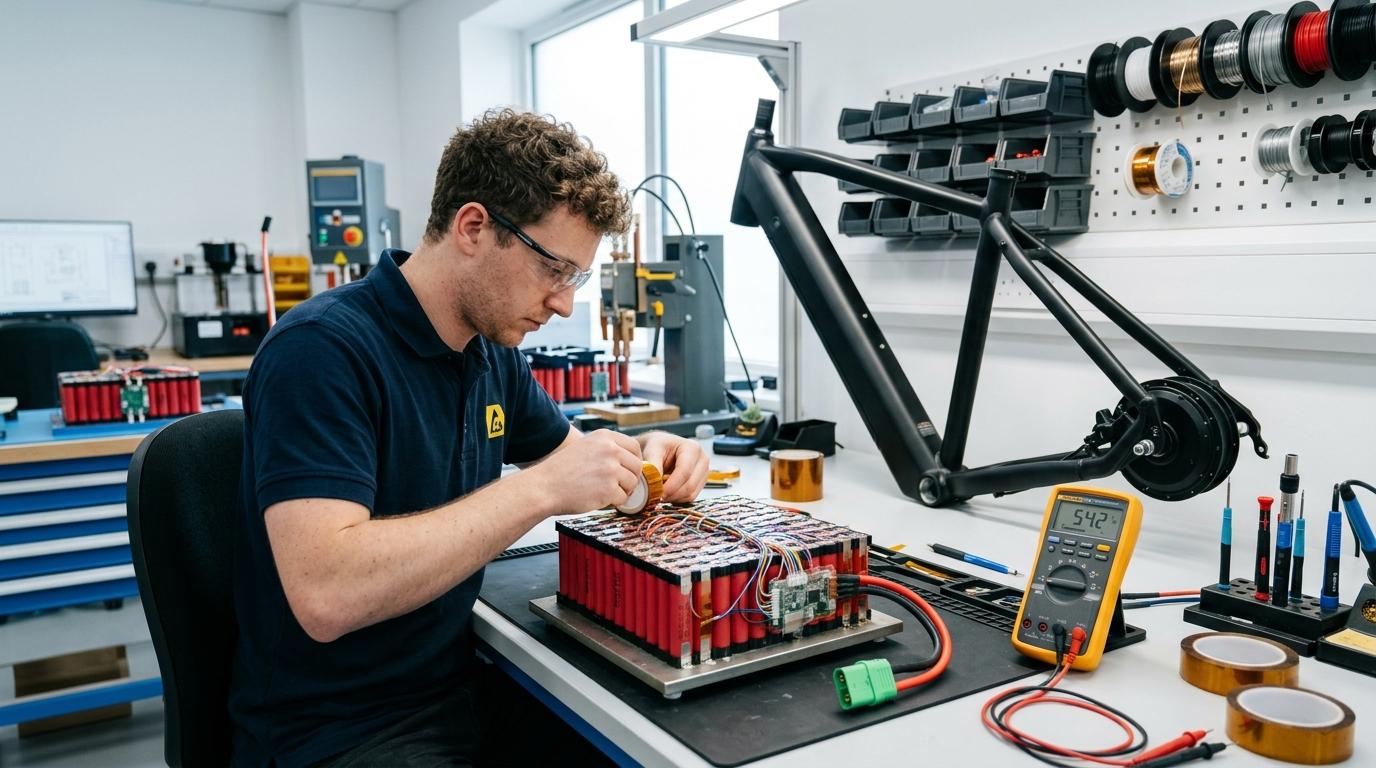
Building Custom Lithium-Ion Battery Packs: Spot Welding, BMS Wiring & Safety Guide
In recent years, electric mobility (e-bikes, electric scooters, solar golf carts) and off-grid portable power stations have seen explosive demand. At the core of every high-performance setup sits a custom-engineered lithium-ion battery pack.
While commercial off-the-shelf battery packs are readily available, they are frequently built using generic low-grade cells, under-rated BMS (Battery Management Systems), and questionable safety protocols. When you build your own pack—or commission an engineered custom build from Shotech—you gain complete control over energy density, continuous discharge rating, cycle longevity, and critical safety cutoffs.
Here is an engineering walkthrough of how we design and build professional-grade lithium battery packs in our workshop.
1. Cell Selection: 18650 vs. 21700 Cylindrical Cells
A lithium pack is only as reliable as its weakest individual cell. We primarily utilize Grade-A cylindrical cells:
- 18650 Cells (18mm diameter × 65mm length): The classic industry standard (e.g., Samsung 25R/35E, LG MJ1, Panasonic NCR18650B). Capacities range from 2,500mAh to 3,500mAh. Ideal for compact frames, triangle bags, and lightweight portability.
- 21700 Cells (21mm diameter × 70mm length): The modern high-density standard adopted by Tesla and high-output e-bikes (e.g., Samsung 40T/50S, Molicel P42A). Capacities range from 4,000mAh to 5,000mAh with exceptional continuous discharge capabilities (up to 35A per cell).
Crucial Rule: Never mix different cell models, varying ages, or mismatched internal resistance (IR) within the same pack. Prior to spot welding, every batch is checked on an AC milliohm meter to guarantee IR variance is under 2mΩ across all cells.
2. Voltage, Capacity & Configuration Math
Battery packs are configured using two designations: S (Series) for voltage and P (Parallel) for current capacity.
- Total Voltage =
Series Count (S) × Nominal Cell Voltage (3.6V or 3.7V) - Total Capacity (Ah) =
Parallel Count (P) × Cell Capacity (Ah)
Common E-Bike & Inverter Configurations:
- 36V System (10S): 10 cells in series × 3.7V nominal = 37V nominal (42.0V full charge).
- 48V System (13S): 13 cells in series × 3.7V nominal = 48.1V nominal (54.6V full charge). Standard for 500W–1000W e-bike motors.
- 52V System (14S): 14 cells in series × 3.7V nominal = 51.8V nominal (58.8V full charge). Delivers noticeable top-end speed gains over 48V on identical controllers.
- 72V System (20S): 20 cells in series × 3.7V nominal = 74V nominal (84.0V full charge). Engineered for high-speed electric motorcycles and high-torque delivery.
For example, a 48V 20Ah pack using 5,000mAh 21700 cells requires:
Parallel Count = 20Ah / 5Ah = 4PTotal Cells = 13S × 4P = 52 cells
3. Structural Assembly & Interconnection (Spot Welding Only)
Cell Spacers & Pure Nickel Strips
Never glue cylindrical cells directly together with hot glue. Cell holders (interlocking plastic spacers) must be used. Spacers maintain an air gap between cells for thermal dissipation and isolate vibrations when the e-bike encounters potholes or rough terrain.
Why You Must NEVER Solder Directly onto Cell Terminals
Soldering irons apply prolonged high heat (350°C+) to the positive and negative cell caps. This destroys the internal polymer separator, degrades the electrolyte, and poses serious thermal runaway risks.
Instead, we use a capacitive discharge precision spot welder with 0.15mm – 0.20mm pure nickel strips (not nickel-plated steel, which has higher internal resistance and rusts over time). Spot welds deliver a pulse of thousands of amps in just 5 to 15 milliseconds, bonding the nickel to the steel cap without transferring heat into the chemical core.
4. The Brain of the Battery: BMS Wiring & Cell Balancing
A lithium pack without a Battery Management System is a hazard. The BMS continuously monitors:
- Over-Charge Cutoff: Halts incoming charging if any individual series group reaches 4.25V.
- Over-Discharge Cutoff: Disconnects load when cell groups drop below 2.80V–3.00V, preventing irreversible chemical death.
- Over-Current & Short-Circuit Protection: Trips instantly within microseconds if an accidental short occurs.
- Active/Passive Cell Balancing: Evens out minute voltage differences among groups during charging.
- Thermal Sensor (NTC): Disables power if cell pack temperature exceeds 60°C.
Wiring Sequence:
- Connect the thick B- lead to the overall pack negative terminal.
- Wire the balance harness pins sequentially starting with B0 (Pack Negative), then B1 (1st series junction), B2, up to B(N).
- Verify each pin on the connector with a digital multimeter before plugging it into the BMS board. A single misplaced balance lead will immediately destroy the BMS IC!
- Connect the output P- lead (Discharge Negative) to the main high-current connector (e.g., Amass XT90-S Anti-Spark).
5. Multi-Layer Insulation & Rugged Waterproofing
Mechanical and electrical insulation is where many DIY packs fail:
- Positive Terminal Rings: Adhesive barley/fish paper rings must be affixed over every positive terminal before welding to prevent the nickel strip from bridging the positive cap to the negative outer rim.
- Fish Paper Barrier: Wrap the entire welded cell block in vulcanized fish paper for flame resistance and puncture prevention.
- FR4 Epoxy Fiberglass Plates: Rigid 1.5mm epoxy sheets on both sides guard against blunt force impact if the bike is dropped.
- Heavy-Duty PVC Heat Shrink: Sealed tightly with industrial heat guns, then reinforced with silicone sealant around cable exits for an IP65 water-resistant finish.
Summary
Building lithium battery packs blends precision electrical calculations, metal fabrication, and strict safety discipline. When done right, you get a lightweight power source that delivers hundreds of high-amperage cycles and reliable power for thousands of kilometers.
Looking for a custom lithium pack for your e-bike, scooter, or home inverter station? Reach out to Shotech Enterprises to discuss your voltage, amp-hour, and form-factor specifications!
Battery & Inverter Runtime Calculator
Calculate real hours of backup for your home appliances or e-bike range based on battery chemistry and DoD.
Book a Technical Consultation
Schedule a 30-minute discovery call for solar site audits, custom battery builds, or web architecture.

Hammed Ogundele
Founder & Lead Engineer at Shotech Enterprises (BN: 7759945)
Full-Stack Software Engineer & Clean Energy Systems Builder. Specializing in high-performance web applications, offline-first systems, custom lithium-ion battery packs for electric mobility, and commercial solar plants for heavy machinery.
Related Articles
View all articlesWhy Inverters Trip on Heavy Machinery: Inductive Loads & Surge Sizing Explained
Why does a 5kVA solar inverter trip the moment a 2HP motor starts? Learn about inductive inrush currents, power factor, transformer topology, and the exact engineering formulas for sizing commercial systems.
Architecting Offline-First Web Applications: Local Databases, Sync Engines & Real-World Resilience
How to build mission-critical web applications that remain 100% operational during internet dropouts and power disruptions—featuring local-first storage, sync queues, conflict resolution, and background workers.