Why Inverters Trip on Heavy Machinery: Inductive Loads & Surge Sizing Explained
Why does a 5kVA solar inverter trip the moment a 2HP motor starts? Learn about inductive inrush currents, power factor, transformer topology, and the exact engineering formulas for sizing commercial systems.

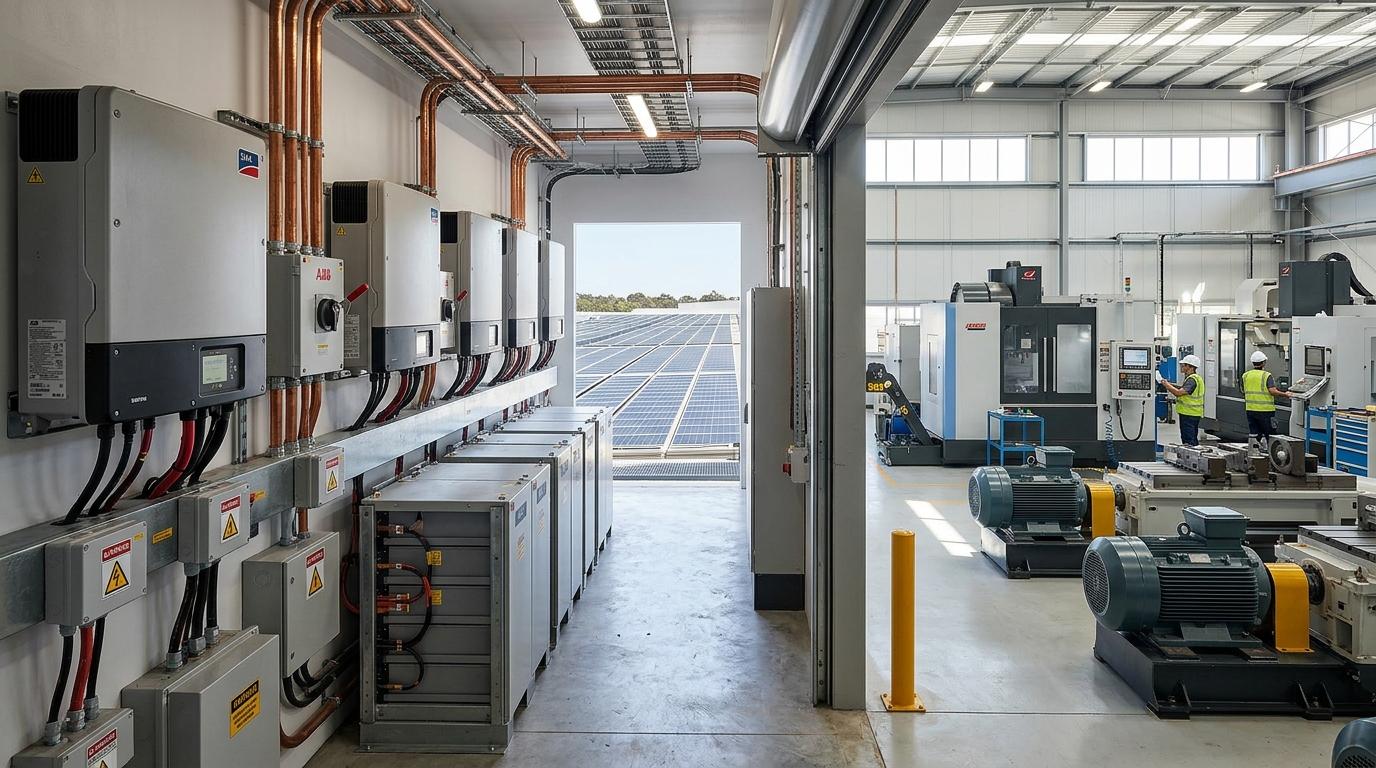
Why Inverters Trip on Heavy Machinery: Inductive Loads & Surge Sizing Explained
One of the most frequent phone calls we receive at Shotech Enterprises goes like this:
"Engineer, I just installed a brand-new 5kVA pure sine wave inverter with four 200Ah batteries. It powers all my lights, fans, and televisions effortlessly. But the second I turn on my 2HP submersible water pump (or workshop milling machine), the inverter screams with an overload error and trips!"
The math on paper seems fine: A 2 Horsepower (HP) motor is approximately 1,492 Watts. How can a 5,000VA inverter—which should easily handle up to 4,000W—fail to start a 1,500W load?
The answer lies in Inductive Inrush Current, Power Factor, and Inverter Internal Architecture. Let’s break down the physics and the engineering calculations needed to run heavy machinery smoothly.
1. Resistive vs. Inductive Loads
To understand why the inverter trips, we must distinguish between two load types:
- Resistive Loads: Light bulbs, electric irons, electric kettles, and toaster ovens. These components convert electrical energy directly into heat or light without magnetic coils. Current and voltage rise together in phase. When you switch on a 1,000W heater, it demands almost exactly 1,000W from start to finish.
- Inductive Loads: Electric motors, borehole pumps, air conditioners, compressors, refrigerators, and machine tool spindles. These devices use heavy copper wire windings to generate rotating electromagnetic fields.
When an electric motor is stationary and switched on, it has zero magnetic field and zero back-electromotive force (Back-EMF). In the first 100 to 500 milliseconds, the motor rotor is physically locked in place while trying to overcome inertia.
During this window, the motor acts almost like a dead short circuit, drawing what electrical engineers call Locked Rotor Amps (LRA) or Surge Inrush Current.
2. The Multiplier: 5x to 7x Starting Surge
For standard single-phase induction motors without soft-starters, the starting surge current is typically 5 to 7 times the motor's rated running current:
- Running Current of 2HP (1.5kW) Motor at 230V: ~6.5A to 8.0A
- Starting Surge Current:
8.0A × 6.5 = ~52 Amperes! - Instantaneous Surge Power:
230V × 52A = 11,960 Watts (~12kVA)
A 5kVA inverter rated for a momentary peak surge of 10kVA for only 20 milliseconds will instantly detect this 12kVA draw and trigger its hardware fast-trip overcurrent protection to save its own switching transistors from blowing up.
3. High-Frequency vs. Low-Frequency (Toroidal) Inverters
Not all 5kVA or 10kVA inverters are constructed equally:
| Feature | High-Frequency (HF) Inverters | Low-Frequency (LF) Heavy-Transformer Inverters | | :--- | :--- | :--- | | Internal Core | Tiny ferrite transformers + switching MOSFETs | Massive copper/iron toroidal transformer | | Weight | Lightweight (8kg – 15kg) | Heavyweight (35kg – 75kg) | | Surge Rating | Usually 2x for only 20ms | 3x to 5x continuous surge for 5 to 10 seconds | | Inductive Tolerance| Prone to tripping on motors & compressors | Easily swallows locked rotor starting currents | | Cost | Budget-friendly | Premium industrial grade | | Best Used For | Laptops, TVs, IT servers, LED lighting | Borehole pumps, lathes, welding machines, factories |
At Shotech, when designing commercial solar installations or industrial workshops, we deploy low-frequency industrial inverters with oversized toroidal transformers that absorb the mechanical kickback without blinking.
4. The Smart Solution: Soft-Starters & VFDs
What if upgrading from a 5kVA to a 15kVA inverter is outside your immediate budget?
Instead of oversizing the inverter solely to handle half a second of startup surge, we install a Variable Frequency Drive (VFD) or a digital Electronic Soft Starter:
- How It Works: Rather than slamming the motor with full 230V 50Hz mains power at startup, the VFD ramps up the frequency from 0Hz to 50Hz smoothly over 3 to 5 seconds.
- The Result: The starting surge drops from 600% down to just 120% – 150% of rated power. Your 5kVA solar system can now start the 2HP machine without any voltage dip or inverter alarm!
5. Industrial 3-Phase Synchronization
For large fabrication workshops, flour mills, or plastic extrusion factories, machinery operates on 415V Three-Phase power (L1, L2, L3 + Neutral).
Attempting to run a 3-phase motor with single-phase power causes phase loss, severe overheating, and motor burnout. We configure synchronized 3-phase parallel solar inverters locked with digital communication cables so that all three 120-degree phase angles remain perfectly aligned in real time.
Summary Checklist Before Sizing Your Solar System
- Check the Nameplate: Locate the full load amperage (FLA) and locked rotor amps (LRA) on every motor.
- Account for Power Factor: Inductive loads run at a power factor of 0.75 – 0.85, meaning
1kW ≈ 1.25kVA. - Choose the Right Topology: Opt for low-frequency toroidal designs when heavy inductive equipment is primary.
- Evaluate VFDs: A small investment in motor control can save you thousands in oversized solar inverters and battery banks.
Need an engineered assessment for your facility, workshop, or home water pump? Contact Shotech Enterprises for on-site load auditing and industrial solar design.
Battery & Inverter Runtime Calculator
Calculate real hours of backup for your home appliances or e-bike range based on battery chemistry and DoD.
Book a Technical Consultation
Schedule a 30-minute discovery call for solar site audits, custom battery builds, or web architecture.

Hammed Ogundele
Founder & Lead Engineer at Shotech Enterprises (BN: 7759945)
Full-Stack Software Engineer & Clean Energy Systems Builder. Specializing in high-performance web applications, offline-first systems, custom lithium-ion battery packs for electric mobility, and commercial solar plants for heavy machinery.
Related Articles
View all articlesBuilding Custom Lithium-Ion Battery Packs: Spot Welding, BMS Wiring & Safety Guide
A practical, in-depth workshop guide to assembling safe, high-output lithium battery packs for e-bikes, electric mobility, and inverter systems—from cell matching and spot welding to Smart BMS wiring.
Architecting Offline-First Web Applications: Local Databases, Sync Engines & Real-World Resilience
How to build mission-critical web applications that remain 100% operational during internet dropouts and power disruptions—featuring local-first storage, sync queues, conflict resolution, and background workers.